Imagine you’re a dragon. Monstrous, tireless, ageless. You have seen the world broken into pieces and assembled back together again. You have travelled the lands of the living and the dead. You know what lurks in both and you have no fear of anything that you have seen, because you are a dragon and nothing is your equal.
Imagine there are men. Little scurrying things that run on two legs instead of four. They are unremarkable prey – small and slow – save for one thing. They think. They understand what you are when you come for them. They feel fear, hope, dread, despair and you have come to savour the taste of those things. They are delicious little treats, rewarding, even if they are hard to winkle out of their holes.
Now imagine that something has changed. Imagine the men have learned a trick. Imagine they have found a way to make you stupid. They no long scurry and hide and fear you, no – now you are their pet. They feed you and nurse you and ride you. They wear your skin for their armour and make bows from your bones. They make you dull, like a dog, with their alchemy. They strip you of your power and and your glory and your rage. For hundreds of years, they grow rich and fat on the back of you. They make you forget what you are and then they forget themselves, and the fear and the dread are all gone and everything is made drab and meaningless.
Imagine you wake up. Imagine you remember. All of it. Imagine the fury.
Now imagine there are thousands of you.
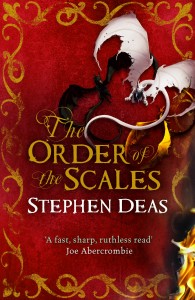
A long time ago, I made some comment about this trilogy coming in layers. The Adamantine Palace shows the surface of what’s going on, glittering and shiny but superficial. The King of the Crags peers beneath, and the Order of the Scales takes you to the heart. That’s the way it was supposed to be, at any rate. I think it has more depth than King of the Crags and I think it flies at a pace to put The Adamantine Palace to shame. I think this is the best of the trilogy by far. If you found the other two fun, I’m quietly hoping this book will blow your mind.
I may, of course, be entirely deluded.
The Order of the Scales comes out in the UK on 19th May. The dragons are by Domonic Harman again. You can read the first chapter here.
Reviews:
“But it’s not the battles or the monsters that captivate, it’s the characters” SFX
“…a fast-paced and violent conclusion to an interesting series, epic in scope but low in bloat, marked out by memorably vicious characters (scaled and unscaled).” The Wertzone
“Great Stuff” Falcatta Times
“enthusiastic … brilliantly executed … heart-thumping dragon action” LEC Book reviews
“The final chapters however are bliss.” “I’m glad to have picked it up and I think you should give it a try.“ A Fantasy Reader
“This is how epic fantasy should be: horrifying dragons, political intrigue, mystery, epic world building, neck-breaking pace, interesting magic and breathtaking battle sequences. There is no wrong or right, there are no heroes; there is only blind ambition, blind devotion, and a struggle to survive. With all its layers and subplots, and a different agenda for pretty much every character, The Order of the Scales proves to be a complex story that will never grow dull.” The Ranting Dragon.
“This is a book that bears some thinking about.” Lowly’s Book Blog
SfSite have a review of the trilogy as a whole: “If you don’t want to get bogged down … and like your fantasy on the dark side you’re going to really enjoy Stephen Deas. “
“a strong bloody finish to the Memory of Flames fantasy trilogy“ according to Alternative Worlds
“unremitting violence at a blistering pace” from Kirkus reviews, but beware, for “also almost everything … is mystifying if you haven’t read the previous books” Yeah. Book three of three thing going on and I didn’t do a recap. Because recaps are BORING.
“The dragons are brilliant…” (Pauline’s Fantasy Reviews, who would definitely like some of the characters to live longer. And possibly be nicer too).
Media Culture have a fairly comprehensive review up
“Pacing aside, it’s very difficult to resist getting caught up in the cold, calculating behavior of Stephen Deas’ majestic and determined dragons.” Citybookreviews stand out from the crowd by finding the story moves too slowly.
A riveting, relentless and violent war of wings, Deas’ dragons are the scariest thing in fantasy today … to be savoured again and again. Fantasy Book Review.
Blood and fire. A must for dragon lovers everywhere. Antipodean SF
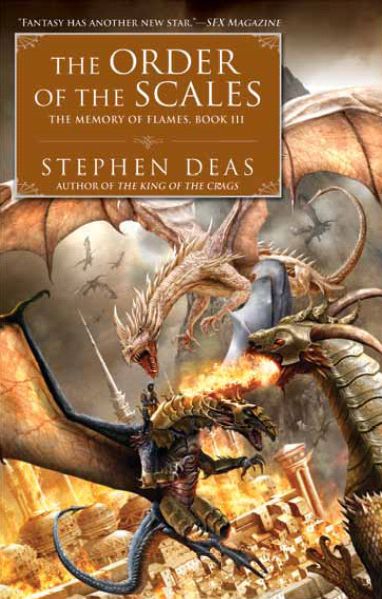
US Cover (artwork by Stephen Youll):
French cover (Alain Brion)